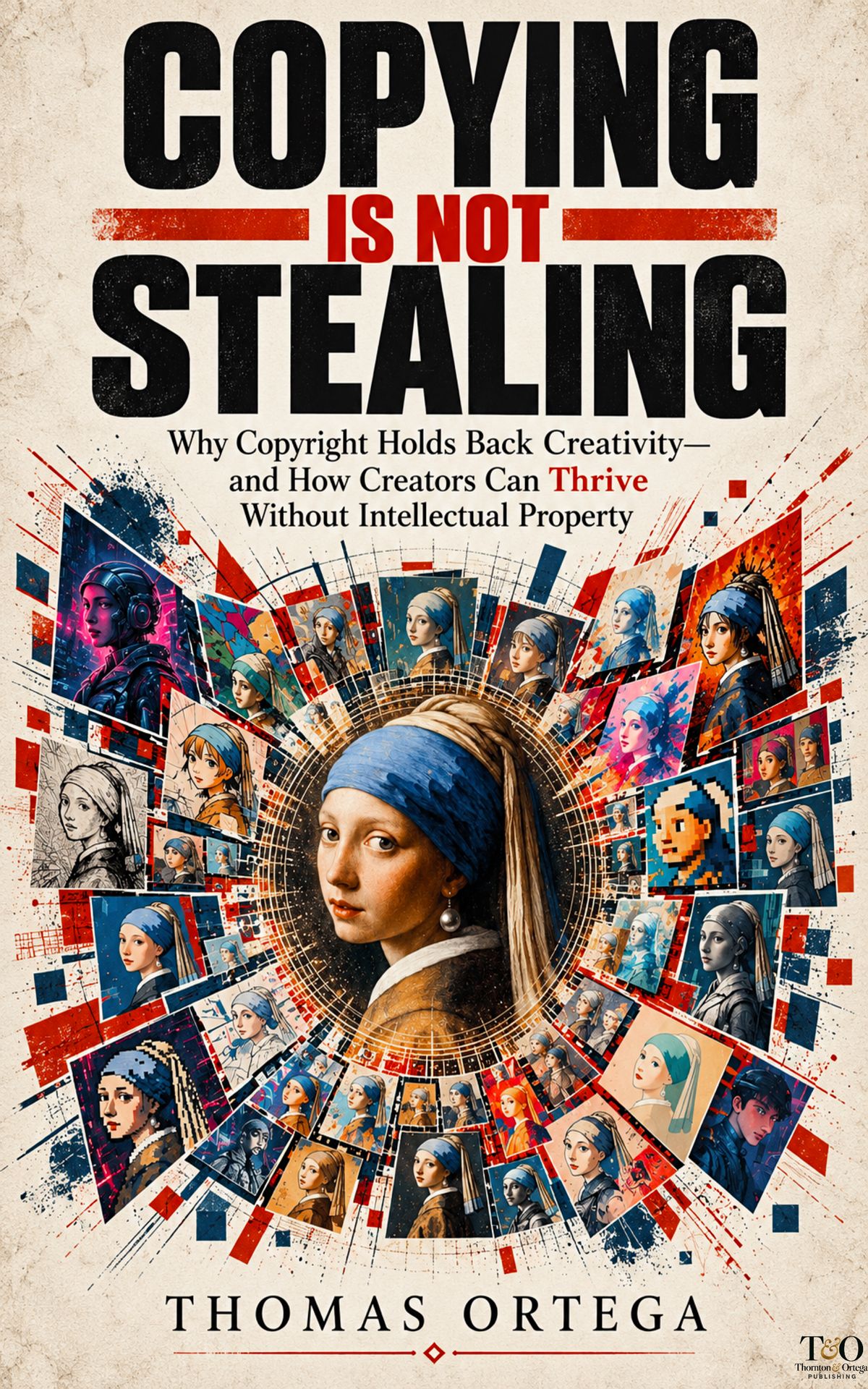
Copying Is Not Stealing
Why copyright holds back creativity, and how creators can thrive without it

10 chapters · 95 pages · EPUB & PDF
$6.99
EPUB + PDF · instant download
- Secure payment by Stripe
- Instant download
- 14-day refund before download
EPUB + PDF · works on any device · no DRM
Paperback · only on Amazon (opens in a new tab)About this book
Arguments about copyright usually end with one of two words: theft if you side with the owner, greed if you don’t. The book sets both aside and asks whether the protection earns what it costs at the length we now grant it.
You come away able to argue from the record that copyright is a privilege granted by statute, not property, and to say exactly where the evidence in its favor runs out.
In 1985 the Supreme Court threw out a charge that bootleg Elvis records were stolen property, because the copyright holder never lost possession of anything. When the 1998 term extension was challenged, seventeen economists, Milton Friedman and Kenneth Arrow among them, showed that its twenty extra years raised the present value of a new work’s expected earnings by less than one percent. The book also confronts the strongest study against it: Italian states that gained copyright under Napoleon produced more operas, and more that lasted, but states that later lengthened their terms got neither more nor better ones.
What you take away is a precise position: the first few years of exclusivity were justified with data, and every year added since rests on assertion.
Questions about this book
Does the book cover fan-made games shut down by cease-and-desist letters?
Yes. Chapter 3 documents fan projects such as Pokémon Uranium, built by volunteers over nine years and pulled after a Nintendo of America takedown, along with AM2R and Chrono Trigger: Crimson Echoes.
Does the book show how creators earn money when copies are free?
Yes. It examines markets where copying is already easy: concert revenue after Napster, Red Hat selling support for free Linux code, Paulo Coelho posting The Alchemist online, and Kickstarter’s all-or-nothing pledges.
Where do the book’s facts and evidence come from?
From court rulings, economic studies and historical records. Examples include the Seventh Circuit’s Sherlock Holmes decision, a European Commission study of piracy and sales, and Eckhard Höffner’s count of new book titles in Germany and England.
Reader reviews
No reviews yet.