Did $4 Gas Boost EV Sales? Where 2026 Car Buyers Really Went
Gas hovered around $4 from April 2026 on, yet new EV sales stalled near 6%. Here's where American car buyers really went, and why the price still worked.

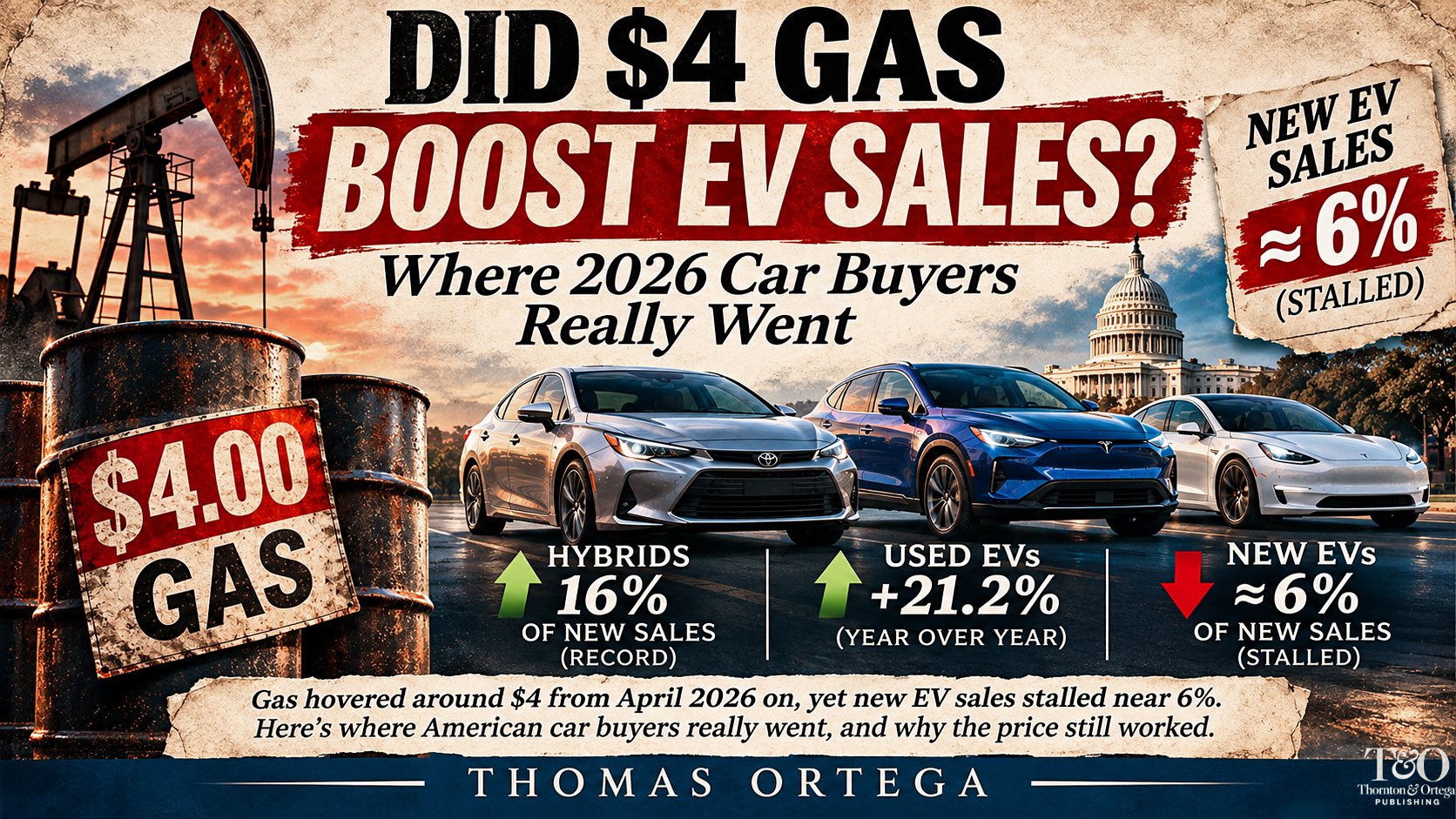
When gasoline crossed $4 a gallon in the spring of 2026, American car buyers did something unexpected. They turned to hybrids and used electric cars. New EV sales barely moved.
The distinction matters. Higher fuel prices pushed buyers toward more efficient vehicles, but not necessarily toward the ones Washington had spent years subsidizing. The market responded. Just not in the way policymakers might have hoped.
That split is the interesting part. The same price at the pump produced three different reactions in three different markets. The one that barely moved was the one Washington had spent years subsidizing.
How high gas prices actually went in 2026
Start with the number, because it gets exaggerated. The war with Iran began on February 28. By early April, AAA's national average had crossed $4 for the first time since August 2022. It peaked at $4.56 on May 21, then slid, briefly dipping under $4 in June.
That peak was not a record. The all-time high, set in June 2022, was just over $5. What made 2026 unusual was duration. AAA reported that this was the first August on record with the national average above $4 every single day, and the average was still around $4.25 in late October.
Roughly seven months of $4 gas. Long enough to change what people buy.
Three markets, one price, three different answers
Hybrids set a record
According to the U.S. Energy Information Administration, conventional hybrids reached a record 16% of new light-duty vehicle sales in 2026. Cox Automotive counted second-quarter hybrid volume up 23% from a year earlier.
Here's the detail worth noticing. Hybrids were not eligible for any of the federal tax credits that expired in September 2025, as the EIA points out. Nobody in Washington paid anyone to buy one. Buyers chose them with their own money.
Used EVs set a record
In September 2026, Americans bought an estimated 47,862 used electric cars, a record 3.3% of all used-vehicle sales and 21.2% more than a year earlier, according to Cox Automotive's EV Market Monitor. The average listing price eased to $36,767. Cox points to a growing flow of off-lease EVs, which put cheaper electric cars on the lot just as fuel got expensive.
New EVs stalled
New battery-electric cars took 6% of new sales in both the second and third quarters of 2026, down from 10% in the third quarter of 2025. The drop was steepest at the top of the market: EVs fell from 31% to 12% of luxury vehicle sales over that year.
You may have seen headlines putting new EV sales down 40% year over year. That comparison is distorted by its own starting point. September 2025 was the last month of the federal credit, and buyers rushed to beat the deadline. In September 2026, the EV share of new sales actually ticked up to 6.5%, mostly because sales of gas cars fell faster.
Why the price and the subsidy pointed in different directions
The tax law signed on July 4, 2025 ended the $7,500 credit for new EVs and the $4,000 credit for used ones on any vehicle acquired after September 30, 2025. The credits had been scheduled to run through 2032. Five months later, the oil shock arrived.
That timing turned 2026 into an unplanned test of what drivers do with an expensive gallon when no federal subsidy tells them which car to buy. They did what the price asked. A subsidy picks a product. A price only poses a problem: you are burning something expensive, so find a way to burn less of it. Then every buyer solves that problem with whatever is cheapest for them.
For most households, the cheapest answer was not a new EV. The average new-vehicle transaction price passed $50,000 in the third quarter, according to Kelley Blue Book figures cited by the EIA. A hybrid cuts fuel use without changing how you refuel. A used EV cuts it further at a lower entry price. A new EV, with the credit gone, asked for the most money up front.
The pattern has been documented before. Studying American car transactions over most of the 2000s, Meghan Busse, Christopher Knittel and Florian Zettelmeyer found that a $1 rise in gas prices raised the market share of the most fuel-efficient quarter of new cars by 20.5% and cut the share of the least efficient quarter by 23.9%, as Kellogg Insight summarized their research. They also found that gas prices move used-car prices far more than new-car prices. In 2026, the used EV lot set records while the new one stalled. That fits: the used market is where a change in the gas price shows up fastest in what a car is worth.
Did buyers think $4 gas would last?
A popular explanation for the stalled new-EV market is that buyers expected prices to fall. The evidence is thinner than it sounds. Using two decades of the University of Michigan consumer survey, Soren Anderson, Ryan Kellogg and James Sallee found that average beliefs about future gas prices typically look like a forecast of no change. Most people assume today's price is tomorrow's.
A simpler explanation fits the data at least as well: the threshold. Cox Automotive research reported by Reuters in March found that most American consumers would consider switching to an EV or hybrid at $6 a gallon. The 2026 peak stopped at $4.56. At that level, a hybrid or a used EV was enough.
The price was also not the only force at work. High interest rates, a new-car market selling fewer vehicles than a year earlier, and automakers' own product decisions all pushed in the same direction. Toyota dropped the gas-only RAV4 when it redesigned the model for 2027, so part of the hybrid surge is simply people buying what is on the lot. That makes the gas price a strong suspect, not the sole proven cause.
What a market price does that a tax struggles to copy
The pattern is older than the modern EV. EPA data show the average new American vehicle peaked at 22.0 miles per gallon in 1987, then drifted down to 19.3 by 2004, while federal fuel economy standards stayed on the books the whole time. Gas was cheap, and buyers chose SUVs. When gas climbed after 2004, the average rose in 2005 and again in 2006. Efficiency isn't a ratchet. It's a response.
Could a tax do the same job? Partly. A study of decades of auto patents by Philippe Aghion and colleagues, published in the Journal of Political Economy in 2016, found that carmakers innovate more in electric and hybrid technology when fuel prices are higher, taxes included. A high tax at the pump pushes buyers and engineers too.
The weakness is durability. The same research found that innovation is path-dependent: a push has to last long enough to redirect where a company's expertise accumulates. Market prices move for reasons investors can study and hedge. Tax paths move when voters push back. France froze its carbon tax at €44.60 a ton after the yellow vest protests. Canada set its consumer carbon price to zero on April 1, 2025, the very day it was scheduled to rise. An automaker planning a fifteen-year platform can hedge oil on a futures market. It can't hedge a finance minister.
What 2026 means if you're shopping for a car
The lesson for a buyer is narrower than the headlines. "Should I go electric?" is the wrong question. A better one: what is the cheapest way to buy fewer expensive gallons, for the miles you actually drive? In 2026, many households answered with a hybrid or an EV coming off lease. For some, the cheapest answer is still the paid-off car already in the driveway.
The subsidy is gone. The price is still talking. It just never told anyone which car to buy.
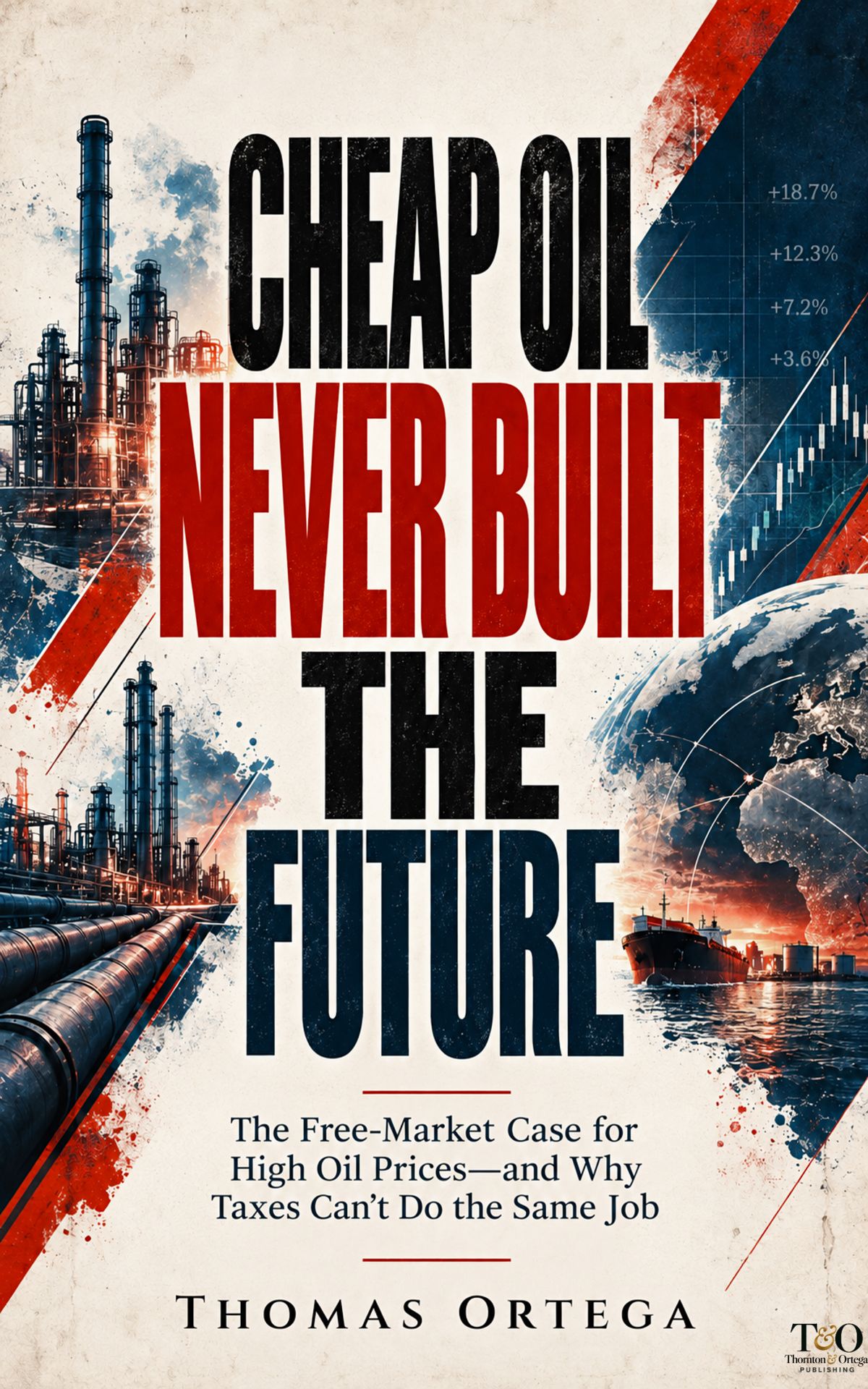
2026 shows what an expensive gallon does to a car lot. The larger story is what a price does to everyone upstream, and why a tax can't carry the same message. I make that full case in Cheap Oil Never Built the Future, my book on why market prices, not taxes, drive energy innovation: innovation comes from price signals and competition rather than taxes, mandates and regulation, and cheap energy alone never built the future.